
The intelligence layer for connected streetlights and smarter streets.
Bring connected lighting and street asset data into one flexible system that delivers new insight, prioritizes issues, drives work orders, and cuts downtime and cost for utilities and cities.
The problem
Reporting what the network sees is not the same as optimizing maintenance in the field.
Cities and utilities did the right thing. They invested in connected lighting and other connected assets in the streetscape to improve performance and enable asset health monitoring. The system that came with the hardware does what it was sold to do. It allows for remote control, and it reports. What it leaves the department holding is everything between a fault message appearing and an asset being fixed.
Alarms, not insight
Vendor systems flood departments with alarms and event data, much of it non-actionable and some of it misleading.
Reactive maintenance
Work and faults aren't prioritized by impact, so the wrong things get fixed first.
A broken loop
Detection rarely turns into a dispatched, verified fix, so KPIs are not reported and the chance to verify an improvement is missed.
Siloed data
No single view across street operations, asset data, work plans, and KPI reporting.
And so the business case stalls. Without prioritization the department cannot put its effort where it counts. Without a closed loop it cannot show that detection led to a fix. Without reporting it cannot prove the saving it was promised.
How it works
One layer, above them all.
Your inbox should hold work, not alarms. StreetOps complements the lighting management system or systems you already run. It decides what issues matter most, checks whether the problem is real, and turns what survives into a job with a crew's name on it.
- 01
Unify your operations
Asset, fault and event data from each vendor's system is normalized into one model and enriched with your sensor and enterprise data. We sell no nodes, so the neutrality is structural rather than promised.
- 02
Rank by impact, on your rules
You set the rules. StreetOps ranks every fault by impact and turns the ones that matter into jobs. When a whole circuit goes dark, it arrives as one incident, not fifteen alarms.
- 03
Check before a truck rolls
StreetOps asks the light itself. It requests a reading, nudges the control, reads again, checks the switch log and returns a verdict — so a crew is sent to something that is actually broken, and so you can let the system create work in the first place.
- 04
Close the loop
Priorities become structured work orders, carried into the field on a native mobile app, verified to closure, and counted — so the saving is a number rather than a claim.
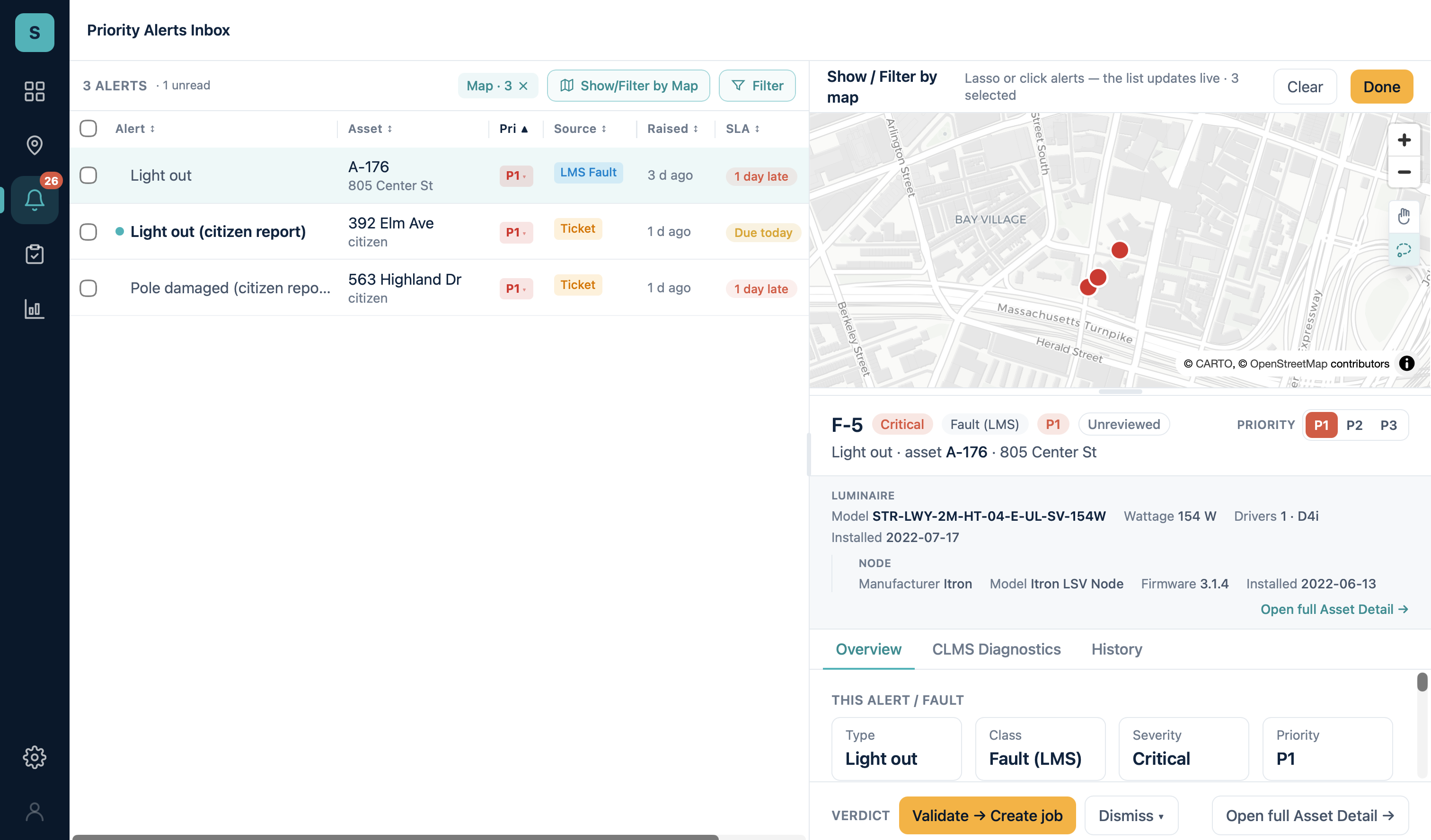
StreetOps CLMS
Central Lighting Management System
It complements the lighting management systems you already run — ranking the flood of faults into a short list, checking the light before a truck rolls, and carrying the work through to a verified fix you can report.
Less downtime. Lower cost. Faster fixes. Increased safety.
Connected lighting was bought to reduce truck rolls, improve first time fix rates and reduce complaints. StreetOps is what finally enables it and delivers the KPI reporting to measure it.
Benefits from enhanced operations
$250–$400
what one truck roll costs a department
Northeast Group, 2026
0.5–2
truck rolls avoided per streetlight incident by deploying a CMS
Northeast Group, 2026
~36%
less crime with increased operational lighting
UChicago Crime Lab
28–42%
fewer accidents with better lighting
U.S. Federal Highway Admin.
Who it's for
Built for the people who keep streets running.
Utilities
Keep the lighting management systems you run and add the intelligence layer above them. Cut downtime and maintenance cost, and lower risk across your program.
For utilities →
Cities
Augment the maintenance processes you already run — fewer lights out, fewer citizen complaints, and KPIs you can report on.
For cities →
Integrators & suppliers
Propose an open, integrable platform that fits requirements and creates new operational savings — and say yes to your customers with backing from a modern technology partner.
For partners →
See your whole streetscape on one screen.
Contact us to learn more. We'll show you your own lighting network with the faults already ranked into work.